
James City Court Records After Arrest
Court records after a James City County jail arrest usually start after the person has been booked into Virginia Peninsula Regional Jail and brought before a judicial officer. VPRJ is the regional jail for James City County, Williamsburg, York County, and Poquoson. Its roster can show custody, booking charges, bond or hold fields, and agency details when those fields are enabled. That jail entry is useful, but it is not the same thing as the formal court case. The court case is built through the magistrate, Williamsburg/James City County General District Court, Juvenile and Domestic Relations District Court when a confidential juvenile matter is involved, or Williamsburg/James City County Circuit Court.
The prosecutor for local criminal cases is the Williamsburg/James City County Commonwealth's Attorney. Virginia uses Commonwealth's Attorneys, not district attorneys. The office represents the City of Williamsburg and James City County in criminal and traffic prosecutions from 5201 Monticello Avenue, Suite 4, Williamsburg, VA 23188, phone 757-564-2277. For the custody side, use James City County jail inmate records; for booking photos, use James City County jail roster mugshots. Court records after an arrest should be read as the prosecution path, not as proof that the person was convicted.
That distinction matters because booking charges can change. An officer may bring a person to jail on a warrant or complaint, the magistrate may set release terms, and the Commonwealth's Attorney may then file, amend, reduce, dismiss, nolle prosequi, or seek indictment on charges that do not match the first jail screen word for word. A final result comes from a plea, verdict, dismissal, or other court order.
Find James City Court Records
The main online starting point is the Virginia Judiciary case information system. It includes adult criminal case information for General District Court and select circuit criminal or traffic information. The Virginia judicial self-help page warns that juvenile and domestic relations case information is not online because of confidentiality, and circuit online access is not uniform for every record type. If a James City County arrest involves a juvenile, sealed matter, expungement, or older archived case, the clerk may be the only practical route.
The official General District Court case-search help page shows the controls used to search and open case details.
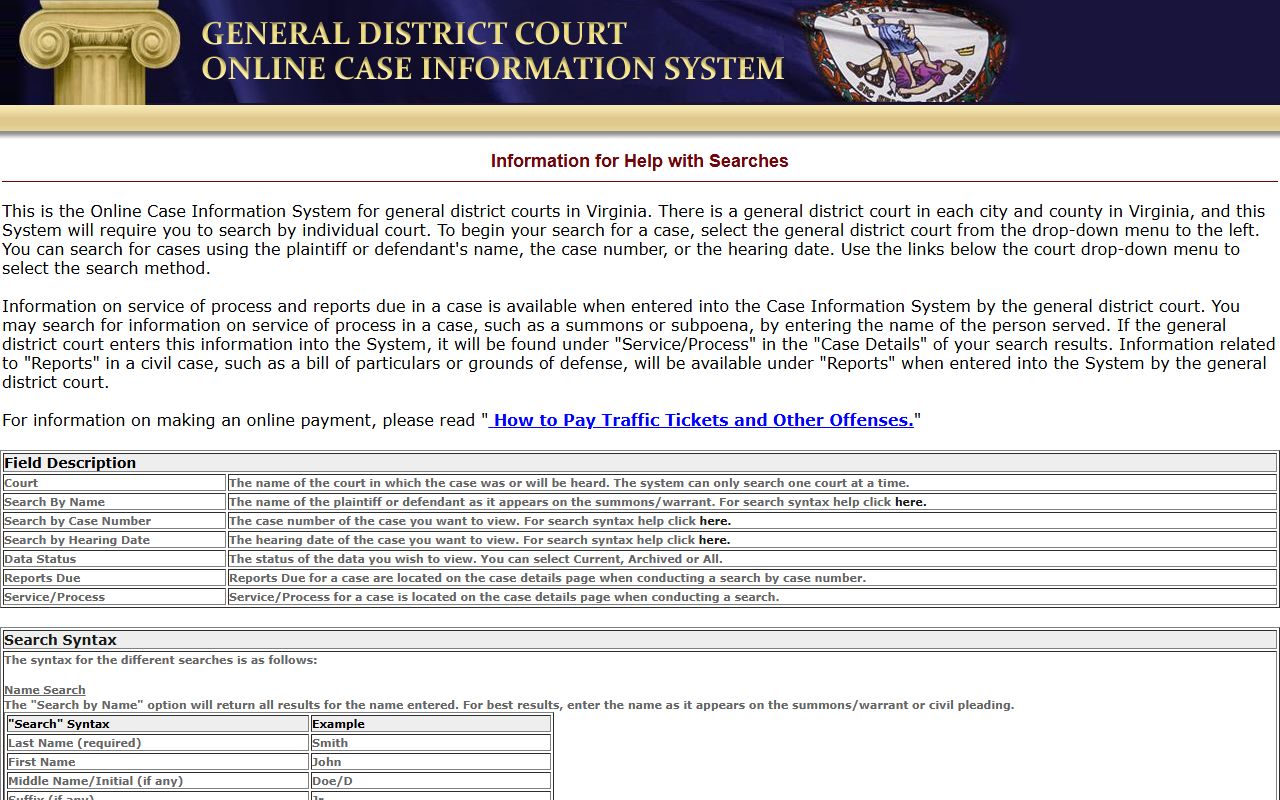
The search tool is statewide, so selecting the correct Williamsburg/James City County court is part of the record check.
| Field Label | Type | Required | Notes |
|---|---|---|---|
| Court | Dropdown/select | Yes | Select Williamsburg/James City County General District Court for local adult criminal, traffic, and felony preliminary matters when applicable. |
| Search By Name | Search mode | Optional mode | Use the defendant's name when no case number is known. |
| Search by Case Number | Search mode | Optional mode | Use this when a warrant, booking, or court notice provides a case number. |
| Search by Hearing Date | Search mode | Optional mode | Useful when the first appearance or next hearing date is known. |
| Data Status | Dropdown/radio | Varies by mode | Current, Archived, or All, depending on the search mode. |
| Case number link | Result action | n/a | Open the linked case number to see details. |
| Display Case Details | Button | n/a | Displays selected case details after results are chosen. |
- Start with the VPRJ roster only to confirm booking date, arresting agency, visible booking charge, and any warrant or case number shown.
- Search the Virginia case system by defendant name or case number and choose the local court that matches the charge stage.
- Open the case detail and compare each charge description, code, case number, court date, and current status.
- If the case moved from General District Court to Circuit Court after certification or indictment, check the Circuit Court channel or contact the clerk.
The local General District Court is in the 9th Judicial District at 5201 Monticello Avenue, Suite 2, Williamsburg, phone 757-564-2400. The Williamsburg/James City County Circuit Court lists 5201 Monticello Avenue, Suite Six, Williamsburg. Circuit Court handles felony trials, appeals, and higher-level criminal matters, including expungement filings.
James City Arrest Charge Documents
The charge record after arrest can begin through a sworn complaint, an arrest warrant, an information, or an indictment. Virginia Code Section 19.2-72 governs issuance of criminal warrants after sworn complaint and probable cause. Virginia Code Section 19.2-80 also matters because it requires prompt appearance before a judicial officer after arrest unless summons procedures apply. That first appearance may address bail, commitment to jail, and the next court date.
| Document | Who Uses It | Common Role | What to Check |
|---|---|---|---|
| Complaint or warrant | Officer, complainant, magistrate, or prosecutor path | Starts the arrest and first court process when probable cause is found. | Offense description, warrant number, charge code, and first appearance information. |
| Information | Commonwealth's Attorney | Formal prosecutor-filed charge used in authorized prosecutions. | Whether it replaces, narrows, or adds to the booking charge. |
| Indictment | Grand jury and Circuit Court path | Moves many felony prosecutions into Circuit Court. | Indictment count, felony level, arraignment, and trial dates. |
Code Section 15.2-1627 gives Commonwealth's Attorneys the duty to prosecute warrants, indictments, and informations charging felonies and allows prosecution of listed misdemeanors and jail or fine threshold offenses. For a James City County court records after arrest search, that means the prosecutor's filed charge is often the more reliable record than the first charge label seen at booking.
James City Charge Status Records
Charge status is the part of the court record that shows where the accusation stands. It can change more than once. A booking charge may be listed as pending while the person is in custody, then the court may show an amended charge, a reduced charge, a dismissal, a nolle prosequi, or a conviction after plea or trial. "Nolle prosequi" means the prosecutor declines to pursue the charge at that time. It is not the same word as acquittal, and it can have different record consequences than a not-guilty verdict.
| Status | What It Means | Record Caution |
|---|---|---|
| Pending | The charge is open and still moving through court. | No final guilt finding has been entered. |
| Amended or reduced | The filed charge changed from the earlier version. | Compare the old and new charge descriptions before relying on either one. |
| Dismissed | The court ended that charge without a conviction. | The arrest and case record may still exist unless sealed or expunged. |
| Nolle prosequi | The prosecutor chose not to continue that charge then. | Eligibility for expungement depends on Virginia law and the case facts. |
| Convicted | A guilty plea, finding, or verdict was entered. | Read sentencing and appeal information before treating the record as complete. |
Bond Changes After Arrest
Bond is tied to both the jail record and the court record. After a James City County arrest, a magistrate or court may release the person on personal recognizance, set unsecured bond, require secured cash or surety bond, deny bond, or leave a hold in place for another agency or court. VPRJ's local FAQ does not publish a full bond schedule and directs the public to a bail bondsmen directory. For current release handling, VPRJ Intake/Release is 757-820-3906 and the main jail number is 757-820-3900.
| Bond Type | How It Works |
|---|---|
| Personal recognizance | Release based on a promise to appear, often called PR release. |
| Unsecured bond | A stated amount may be owed if conditions are violated or the person fails to appear. |
| Cash or secured bond | Money or security must be posted before release. |
| Surety bond | A licensed bondsman posts bond under a fee or collateral agreement. |
| No-bond hold | The charge, warrant, or court order does not permit release at that stage. |
| Detainer or hold | Another court, probation/parole office, federal authority, or immigration agency may block release. |
Bond can change after later hearings, so a roster bond field may lag behind a court order. VPRJ's April 17, 2026 public notice also warns that the jail does not solicit or accept phone payments for release options or bond-related matters. Treat any call demanding bond payment by phone as a red flag and verify through official numbers.
Warrants and Capias Records
A warrant or capias can be the reason a person moves from law-enforcement contact to a VPRJ booking. James City County has a Most Wanted page, but research did not locate a complete official active-warrant search database for the county. VPRJ's warrant FAQ gives the practical rule: contact the local police department or sheriff's office to ask whether someone has an outstanding warrant. The county Most Wanted page is selected public-safety information, not a full warrant index.
Warrant and capias records may also appear inside the court case when public access is allowed. A capias is a court order to take a person into custody, often tied to a failure to appear or other court issue. Once a person is arrested on that process, VPRJ may list the person after intake, and the court record may show the next hearing, bond, or capias context. Do not advise someone to appear at the jail on a possible warrant without confirming with counsel, the court, or law enforcement.
Charges vs Convictions
An arrest and a filed charge are accusations. A conviction is a final court result after a guilty plea, guilty finding, or verdict, subject to appeal and other post-case events. Virginia court records after an arrest can show both, but they should not be treated as equal.
| Point | Charge | Conviction |
|---|---|---|
| Stage | Accusation filed after arrest or through later prosecutor action. | Final guilt result from plea, verdict, or finding. |
| Proof level | Based on probable cause or filing authority, depending on the stage. | Requires proof beyond a reasonable doubt or a guilty plea. |
| Roster link | May match the booking charge or may differ from it. | May appear only after disposition and sentencing. |
| Use caution | Does not prove guilt. | Still needs sentencing, appeal, and record-access context. |
Sealed and Expunged Records
Virginia has separate expungement and sealing paths. Code Section 19.2-392.2 covers expungement petitions for eligible records after acquittal, dismissal, nolle prosequi, mistaken identity, absolute pardon, or listed conviction-vacatur circumstances. Virginia also has a separate criminal-record sealing chapter. The official court form CC-1473 is the petition for expungement filed in circuit court.
| Point | Sealed | Expunged |
|---|---|---|
| Public view | Access is restricted from ordinary public searches. | Eligible police and court records are removed from public access under the expungement order. |
| Where filed | Handled under Virginia sealing procedures when the record qualifies. | Filed in Circuit Court by petition, including form CC-1473 when appropriate. |
| Eligibility | Depends on the sealing chapter, the offense, timing, and case result. | Depends on Section 19.2-392.2 and the specific disposition. |
| Effect on lookup | Online public search may not show the case. | Public court and police-record access may be barred by court order. |
Juvenile records, sealed files, expunged files, and confidential domestic matters can be absent from online results even when an event did occur. That absence should not be treated as proof that no case ever existed.
Record Use Limits
Virginia public records can help a person understand what happened after an arrest, but public lookup is not the same as an FCRA-compliant background check. Court, jail, warrant, and police records can be incomplete, delayed, sealed, expunged, or wrong. The official source for a case is the clerk or agency that maintains the record, and Virginia FOIA exemptions can limit law-enforcement disclosures.
Important: Do not use public lookup results for employment, credit, insurance, tenant screening, or any FCRA-covered decision.
Restricted James City Court Records
Virginia's public-records rules start with a presumption of access, but exemptions matter. The Virginia Freedom of Information Act applies to public records unless a statute allows withholding. Code Section 2.2-3706 covers law-enforcement records and adult arrestee photographs, including limits that can delay release when a felony investigation would be harmed. Code Section 17.1-208 generally opens nonconfidential circuit clerk records for inspection, with copy fees allowed.
For James City County, a request may need to go to different offices depending on the record. VPRJ Records is 757-820-3908 and FOIA requests for the jail can use FOIA@vprj.org. County FOIA requests can go through the public-records request center, by mail to FOIA Request, P.O. Box 8784, Williamsburg, VA 23187, or in person at 101 Mounts Bay Road, Building D, Williamsburg, VA 23185. The county FOIA officer is Ania Eckhardt at 757-253-6602, while sheriff-held records are routed to Sheriff David Hardin at 757-564-2220.